In the role of the ultimate observer, a writer focused on detail and truth, it makes perfect sense why she would do this, but it begs the question: Should you be keeping a notebook like Didion’s? In her 1966 essay, "On Keeping A Notebook", she argues that it’s quintessential for you to.

In the words of devoted diarist Anaïs Nin -- and reinforced by creative life force Phoebe Waller-Bridge -- "We write to taste life twice." Writing something down can be the difference between permanence and forgetting, creating and remaining stagnant. Thus why Didion was so adamant about being in constant motion when it comes to writing.Keeping a notebook was her way of telling stories to herself, some of which involved her, to remember the way she thought and felt about them in that moment in time. She thought of writing in her notebook as a way of reimagining life, with each page acting as a time capsule for the woman she was a day ago or 8 years ago.
Joan Didion “on keeping a notebook”. Writing ✍️ on a notebook activates our mercury placement positively. Specially writing by hand with a green pen (mercury’s color is green). pic.twitter.com/KIUbPxBw8w
— Shravana666 (@shravanaflower) June 13, 2025
By this principle, you can live hundreds and even thousands of lives just through the act of writing. But at the core of it, what she wanted most was to "remember what it was to be me." To freeze a moment of thrill or sadness or doubt through language, safekeeping thoughts and experiences that make up who she was.In her essay, Didion admitted that the way she wrote about events or conversations wasn’t always biblically accurate but rather a retelling of them, honing in on details/descriptions that created the atmosphere and feeling she had. Forever documenting the way she viewed things, and how that changed over time.

Having this type of transcription of your life is incredibly valuable, especially in a time when our memory and retention seems to be getting worse. The growth of short-form content has made it harder for us to engage with anything long-lasting, including our own lives. However, taking the time to reflect and write down a thought or anecdote can greatly help people slow down, be more present in their lives, and simply remember. As Didion wrote about in 1966:
"We forget all too soon the things we thought we could never forget. We forget the loves and the betrayals alike, forget what we whispered and what we screamed, forget who we were. I have already lost touch with a couple of people I used to be."
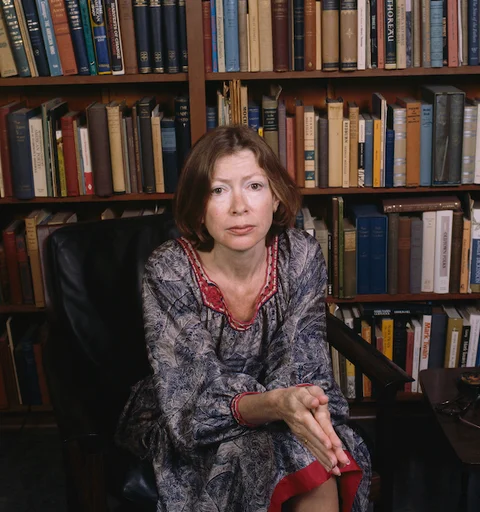
(Author Joan Didion, 1981. © Janet Fries/Getty Images)
Keeping a notebook is then an act of resistance against forgetting that measures growth and helps you stay in touch with all of the people you’ve been.

There are different ways of keeping a notebook, like journaling or having a diary, and there’s no right or wrong way of doing it. But the idea is to have a place to exist outside of technology, outside of a cloud or file, and practice taking the time to slow down enough to write about yourself and the world around you.
This idea gets harder to realize the further we stray from analog tendencies; however, with a return to analog seen among Gen-Z, physical media and, therefore, physical journaling are climbing in popularity. There’s also a kinetic aspect to handwriting something down that can help you remember things easier by connecting the mind with the physical body.This act requires you to actively think about the shapes, letters, and spelling coming to life though your hand and pen. Therefore, handwriting makes you more aware about your thoughts and what you're trying to say by working with your own physiology.
The reflective nature of writing helps you not only with memory but also with processing and further understanding events and reactions long after they happened. It helps you make sense of life by deconstructing and retracing how you ended up where you currently are, then giving you the gift of acknowledging and breaking patterns in the future.We can then start thinking of writing as a tool for reflection and rewiring our brain. Almost as a form of manifestation, but also as an opportunity to change the way we think and speak to ourselves and how we then interact with the world around us. Thus, per Didion's ideology, writing helps us know ourselves and retain fleeting stories on the page. And furthermore, it can also help us build a life closer to the one we want to be living through recollection and awareness.