Danny Boyle & James Franco
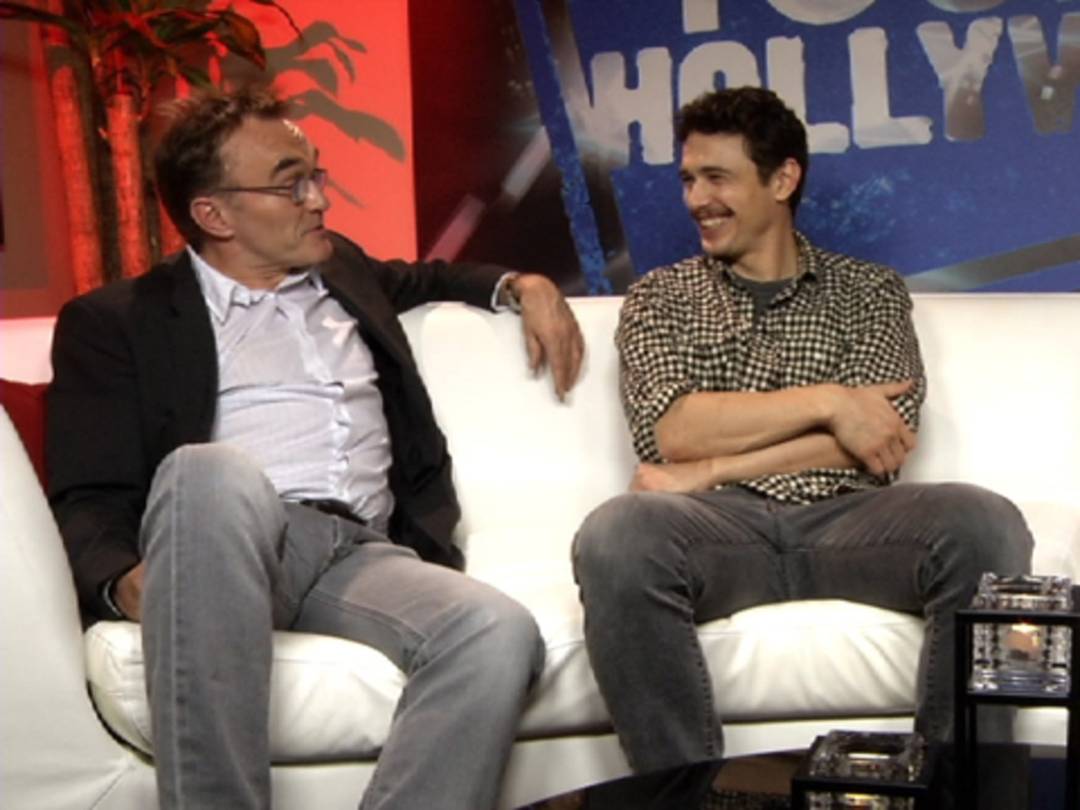
About this video
James Franco and Director Danny Boyle drop by to talk about surviving their new film '127 Hours.' Coasting along on Oscar buzz, find out what makes this film unique from Danny's previous works, namely his runaway hit 'Slumdog Millionaire.' Hosted by Louise Brady.
Chapters (6)
Show ↓
Key Moments (4)
Show ↓
Key Topics (4)
Show ↓
- James Franco
- Danny Boyle
- Louise Brady
- Aron Ralston
Full Transcript
Show ↓
Welcome to Young Hollywood. And Louise Brady, and with me now is Danny Boyle and James Franco. This is fantastic. We've got this awesome new film out, 127 Hours.
Oh my gosh. It's real pleasure to be here. Thank you. It's based on a true story of Aaron Ralston, who was a mountain climber. In 2003, he was trapped under a boulder in Utah. He had a digital camera with him, like a consumer camera, which he kept, and he recorded a series of messages as he died, basically, over these five days. And they're incredibly intimate messages.
When Danny hired me, I knew that these videos existed. I remember asking you if I could see them. And you had told me that he didn't show them to many people. So I thought they were going to be, you know, that he was going to be in a horrible state. He might be so emotional that it just would be slightly embarrassing or he just wouldn't want people to see that. In fact, it wasn't anything like that. He was very composed, because he did think he was going to die. And he's actually on these videos talking about his own death. Because at that point he doesn't know that he's going to survive. It's actually this incredible strength that you see, even though it's all very simple and unemotional. Um, unemotional but, you know, not wallowing in self-pity. And because of that, actually, it's even more powerful.
Ironically, he's dying from his position as an amazing athlete. He's declining, he's losing all that power. But what he's gaining is knowledge really about himself, the way he's been, the way he's behaved to others. And how important in the loneliest of places people are, you know, that just and that it's there. That connection with them, which he makes through this camera, sort of pulls him out of there. And gets reborn, really. He gets given another chance, another chance of life.
Have you thought to yourself or asked yourself that question, if you were in his position, could you really cut off your own arm?
No question, everybody would do it. It's problematic about how many would succeed, but you'd do it. And if you didn't have a knife, he has a knife which he's dulled, which is blunt. He does it with that, which is extraordinary. It does take him a long time. But if you didn't have a knife, you'd do it, you'd chew it off. I mean, it sounds so brutal, but actually, of course, we're when you when you take everything away, and you're just left with this simple thing which is life, which is about to finish, what are you going to do? Do you want to keep it going? And the power of the people in his life, who he feels he's got to connect with again, just will make him do anything. And we will do it. It's an amazing euphoria you feel when he does get through what he has to do and and get out of there. People talk about feel-good movies and we made one like last year, Slumdog Millionaire. And this is proper euphoria. It's very deep. And I remember selling it to the studio saying it's a story about one guy on his own in a canyon for six days, five days. And at the end he cuts his arm off and then they went, "Goals." You know, you can imagine. And they said, "Well, there'll be a dance at the end." I think it's what they said if I remember. Because I think that worked the other time. And I remember saying to James, "We've got to get a dance in here somewhere, James." And there is a great dance.
Are you gonna take credit for that? That was a spontaneous thing I did.
James knew how to make this film a hit. Give them a bit of a dance. And there's a lovely bit actually when he does get free and he does James's version of the I don't know what dance it was actually. It's a nameless one, I think.
Kind of like I would imagine someone like like a gold panner, like when he finds gold. Yeah, hippity hopppity. You know, kind of.
Timestamps are approximate — click one to jump the player.
PEOPLE MENTIONED
- Danny Boyle
Director of '127 Hours' and 'Slumdog Millionaire', interviewed in the video
- James Franco
Actor in '127 Hours', interviewed in the video
- Louise Brady
Host of the interview
- Aron Ralston
The real-life mountain climber whose story '127 Hours' is based on
FAQ
What is the film '127 Hours' about?+
Who directed '127 Hours'?+
Who is James Franco in '127 Hours'?+
Did Aron Ralston record himself during his ordeal?+
What other film by Danny Boyle is mentioned?+
MORE FROM YH STUDIO
Hand-picked by the Young Hollywood editors — the stories shaping YH Studio this week.



From The Scene
MORE READING ON JAMES FRANCO
Seth Rogen Joins the New Darkwing Duck Series Cast
By The YH Wire
When Actors Portray Other Actors & Musicians!
By Katie Marzullo
8 Great Movies About The Movies!
By Rachel Rosenfield
Everything You Need to Know Before Seeing 'Spider-Man: No Way Home'!
By Meredith Reilly