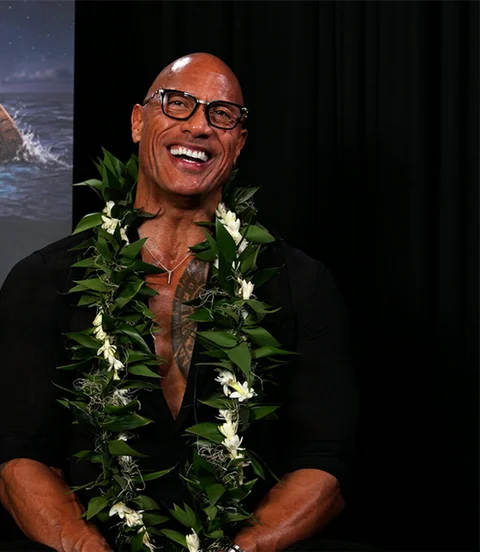

Dwayne “The Rock” Johnson is a behemoth, a cultural icon who broke his way onto our screens in the WWE world and soon became one of the most bankable Hollywood stars of all time. For years, he’s been the guy you call when you need a skyscraper climbed, a jungle survived, or a franchise supercharged. But in Benny Safdie’s The Smashing Machine, Johnson trades in catchphrases and explosions for something quieter and riskier: the life of real MMA fighter Mark Kerr. The gamble pays off, giving us Johnson at his most vulnerable, and proving there’s a depth beneath his tough guy exterior.
Based on the 2002 documentary The Smashing Machine: The Life and Times of Extreme Fighter Mark Kerr, Safdie’s biopic follows Kerr (Johnson) through his rise as a wrestling prodigy-turned-MMA champion, and the personal battles that threatened to undo him. The film -- which premiered at the Venice Film Festival to a standing ovation and took home the Silver Lion for Best Director -- is raw, often brutal, and unafraid of leaving its audience as battered as its subject.
Safdie, known for his chaotic, nerve-jangling work with his brother Josh in Uncut Gems and Good Time, makes his solo feature film debut here. His fingerprints are all over the movie -- handheld camerawork, grainy 16mm textures, and a restless energy that blurs fiction and documentary. The film jumps between New Mexico gyms, Tokyo arenas, and Vancouver backdrops, the camera often lingering voyeuristically outside the ring. In fact, Safdie rarely lets us see a fight the way ESPN would frame it; instead, the camera circles from the stands, backstage, or just behind Kerr’s shoulder, emphasizing the alienation of a man who can only connect through violence.
And yet, beneath the prosthetics and wig designed to mold Johnson into Kerr, it’s Johnson’s own personality that shines through. His Kerr is a hulking, inverted pyramid of muscle with a surprisingly meek, almost hesitant voice. In voiceover, he talks us through his process -- not with the steely bravado typical of The Rock but with a quiet calculation of how to inflict damage before it’s inflicted on him. It’s a startling contrast: the gentle giant who wants safety, trapped in a sport that demands blood.
This is not the sleek charisma of Luke Hobbs or the mythic swagger of Black Adam. Johnson lets the movie strip away the Rock persona to reveal something scarred, frightened, and deeply human. It’s not always graceful -- the prosthetics can be distracting, and his movie-star polish sometimes peeks through -- but when the quiet moments land, especially in scenes where Kerr reflects alone, the effect is haunting. Critics at Venice weren’t exaggerating when they buzzed about a potential Oscar nomination.
Emily Blunt plays Dawn Staples, Kerr’s then-wife, and while Blunt commits as always, the script doesn’t give her as much to do. Dawn’s love of risk and danger makes her a sharp counterpoint to Kerr’s yearning for peace, but the film is most alive when Johnson is alone, fumbling through his contradictions. Still, one beautifully staged sequence at an amusement park where Kerr tries to cling to normalcy while Dawn leans into chaos, crystallizes the couple’s push-and-pull dynamic.
If the narrative falters, it’s because Safdie consciously resists the typical sports biopic arc. Don’t expect a triumphant training montage or a neat rise-fall-redemption cycle. Instead, The Smashing Machine unfolds like a slice-of-life tragedy: repetitive, numbing, sometimes even narcotized. Safdie seems more interested in capturing the rhythm of Kerr’s existence than sculpting it into a clean story. Depending on your taste, this is either frustratingly shapeless or bracingly authentic.
The fights, though, are something else. Safdie stages them less as crowd-pleasing spectacles and more as choreographed expressions of pain. Every punch feels artistic, every chokehold intimate, with Belgian musician Nala Sinephro’s score swirling in dissonant waves around the chaos. As a wrestling movie, The Smashing Machine joins the lineage of The Wrestler, Foxcatcher, and The Iron Claw. Like those films, it uses combat sports as a stage to explore fragility, addiction, and masculinity. But where The Wrestler leaned into elegy and The Iron Claw into tragedy, Safdie gives us alienation: the sensation of a man whose empathy rules his life, even as he’s trapped in a body of a gladiator and a profession built on brutality.
Ultimately, The Smashing Machine is worth seeing not for its uneven story or even for Blunt’s capable turn but for the spectacle of Dwayne Johnson finally smashing through his own image. This is not “The Rock”. This is Dwayne Johnson bruised, uncertain, and, for the first time in his career, fully human.
On This Topic